The Queen of Mulch: Ruth Stout's No-Till Garden


It was the same frustrating story every spring. Right when Ruth Stout wanted to plant her first vegetables, the neighbor’s tractor broke down and he couldn’t plow her garden patch. When it happened yet again in the spring of 1944, Ruth walked out to her garden and looked sadly at her thriving asparagus plants. “Bless your heart, you don’t have to wait for anyone to plow you,” she said. Then she had a revelation. “One never plows asparagus and it gets along fine...Why plow? I AM NOT GOING TO. I AM GOING TO PLANT!”
Taking a closer look at her garden, Ruth saw that the soil was mostly covered with crop residues and leaves. Underneath, the ground was “so soft and moist” that she could easily make a hole with her finger to plant seeds. She raked the mulch aside, planted her seeds, and snuggled the mulch back around them after they germinated. That first year wasn’t perfect—the mulch wasn’t thick enough to fully suppress weeds—but the experiment was so successful that Ruth decided she would never plow again. And she didn’t.
Over the next four years, Ruth refined and improved her no-till mulch system. She mulched her garden with manure, vegetable wastes from the kitchen, and—most importantly—a thick layer of spoiled hay from a neighboring farm. An eight-inch layer of hay, which compacted down to about two or three inches of solid mulch, provided good weed control and kept the soil moist.
After several years of her no-till mulch system, Ruth’s vegetables were bigger and tastier than ever before. The plants were healthier, too—she found that she no longer needed to spray pesticides. Without knowing what the term meant, she became an organic gardener. Best of all, her new system was so much easier that it gave her lots more time to engage in her other favorite leisure activities—taking a nap or reading novels on the couch. She figured she could keep gardening with mulch until she was in her nineties, even if she was in a wheelchair.
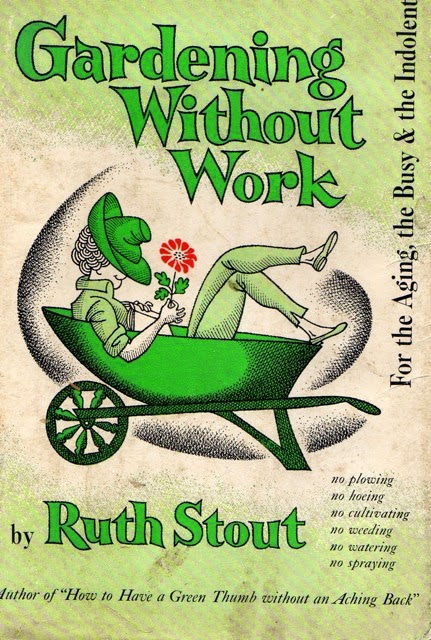
In 1953, Ruth sent Organic Gardening magazine an article on mulching, which was “promptly and unceremoniously lost.” But she wouldn’t take no for an answer. The first of many articles by Ruth Stout, “Throw Away Your Spade and Hoe,” was published in the July 1954 issue. Her first book on mulching, How to Have a Green Thumb Without an Aching Back, was released in 1955, followed by Gardening Without Work and The Ruth Stout No-Work Garden Book.
After Ruth’s first book came out, her quiet life of leisure was interrupted by a stream of visitors who wanted to see her famous mulched garden for themselves. Organic Gardening and Farming included her garden in its first-ever list of organic farms to visit in 1955. At first, Ruth was excited by the visitors, but as the trickle turned into a flood, she wasn’t able to give them much individual attention. By 1976, over 7,000 people had made the trip to Poverty Hollow, Connecticut to see Ruth’s rich soil and healthy plants for themselves.
In 1976, Organic Gardening filmed a video titled “Ruth Stout’s Garden.” Still gardening at age ninety-two, Ruth showed the filmmakers how she simply raked the mulch aside and dropped seeds on the ground, lightly brushing the earth over them with her hands. She dropped sprouting seed potatoes on the ground, then covered them with a thick layer of mulch. Her goal of being able to garden through old age with her mulch system was realized. And she helped make mulch an integral part of organic farming—right up there with the compost pile.


