Losing History: Why Aren't We Preserving the Historical Sites of the Bicentennial Era?

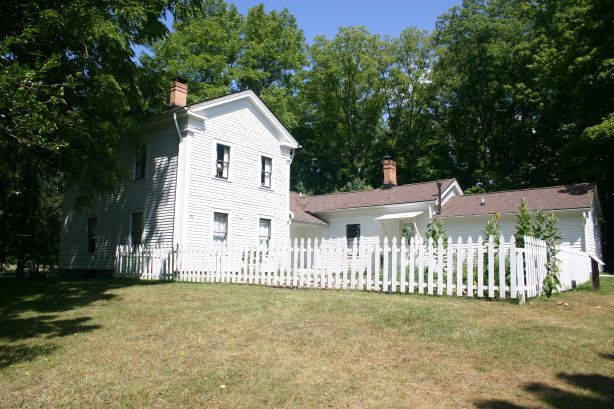
The path curves out of sight, its destination hidden by thick forest. “When we go around that curve, we’re going to travel back in time to the 1880s,” I tell the eager group of fourth-graders who are at the Kalamazoo Nature Center for a field trip. “Really?” one wide-eyed girl asks. “Well, you can’t actually travel back in time,” I clarify. “But this is the closest you can get.”
We round the corner and reach the first destination on our time-travel adventure—an old corncrib. It’s empty now, but I tell the kids how corn used to be harvested in the ear rather than combined like it usually is today. Then we head up the path to the granary, where I put an ear of field corn into an antique corn sheller and turn the crank. A stream of golden kernels pours out the bottom into a pail, while the kids shriek with excitement as the empty cob pokes out of a hole on the front.

There are other outbuildings—a blacksmith shop, a chicken coop, and even a fruit-drying shed. It’s the only fruit-drying shed I’ve ever seen at a historic site. The tiny, windowless building is mostly filled with wood-slatted racks, with a tiny, rusty wood stove on one end to provide heat for drying. I can just picture the racks full of sliced apples or peaches, wrinkling slowly in the heat from the little stove.

The main attraction, of course, is the historic farmhouse. Built in 1858, the DeLano House has been restored to its nineteenth-century décor. The kitchen features a big wood-burning cookstove. The upstairs bedrooms have soap stones on the beds and chamber pots under them. There’s a big walking spinning wheel in the parlor. Enough notes on the pump organ work for me to play one stirring verse of “The Battle Hymn of the Republic.” Even the squirreliest kids sit spellbound, not budging an inch until the last haunting notes die away.

After the kids leave, I discover something fascinating in the attic of the granary. This museum owes its existence to the Bicentennial. A pile of old, mouse-chewed papers tell how passionate people raised funds, restored the house, moved the outbuildings from another farm, and started interpreting it as a historic site. On July 4, 1976, they planted a commemorative maple tree in the parking lot. It was marked on the old maps as “Liberty Tree.”
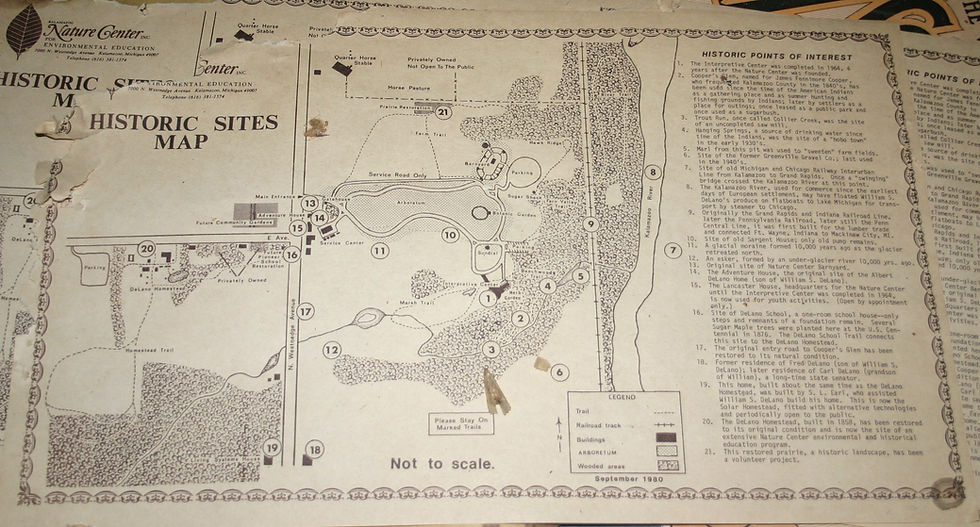
By the time I worked at the Kalamazoo Nature Center in the summer of 2014, the Liberty Tree was big and beautiful, but nobody knew it had been planted on a significant date. The historical buildings that people worked so hard to save in the 1970s were in poor repair. Over the next five years, I watched the fruit-drying shed deteriorate due to a hole in the roof that nobody cared enough to fix. By 2019, it was gone. That unique piece of Michigan history was lost forever. And it looks like the Nature Center is no longer using the DeLano House for field trips or special events. Today's fourth-graders can't go on the same historical field trip that I helped teach twelve years ago.

It’s a troubling trend that I’ve noticed at other historic sites, too. Michigan is dotted with historic villages of mid- to late-nineteenth-century buildings that owe their existence to the Bicentennial fascination with history. Often, these historic sites are only open for limited hours because they’re run entirely by volunteers. And many of the deteriorating wooden buildings won’t make it another fifty years without some major repairs.
Will the 250th anniversary of the United States rekindle interest in these neglected historic sites? It hasn’t yet, but there’s still time. Why don’t we use this semiquincentennial year as an opportunity to preserve these historic buildings and ensure that the kids of today and tomorrow can experience the wonder of time-traveling to nineteenth-century rural America?


Comments