The Birthplace of No-Till: Visiting Golden Valley County, North Dakota


June 22, 2026
I wake up as soon as it gets light and pack up my wet tent. It’s beautiful and sunny this morning, with no wind. I’m not due at the farm I’ll be touring until 8:00 a.m., so I decide to stretch my legs on the short Wind Canyon nature trail. There’s nobody there at 5:30 a.m.; I have the beautiful scenery all to myself. On the way there, I drive right through a bison cow-calf herd. I’ve been wondering where the cows and calves were, because all the bison I’ve seen in the past two days were bulls. Well, this morning they’re right at a prairie dog town overlook.

The bison cows are industriously rubbing their massive weight on the interpretive signs to help shed their shaggy winter coats. They’ve already knocked one board off a bench and are working on the others. The calves have lighter brown coats than their moms and they’re frisking and playing and enjoying the lovely morning. I even see one nursing! They act a lot like domestic cattle, except bigger, stronger, and wilder. The Black Angus I saw driving through ranches yesterday suddenly look small and puny in comparison.
After a quick picnic breakfast, I somewhat reluctantly bid farewell to Theodore Roosevelt National Park and get on westbound I-94. The spectacular badland scenery continues for several miles, first in the park and then in the Little Missouri National Grassland. Then, quite abruptly, I’m in farm country again. The land is almost completely flat, planted in crop fields. This is Golden Valley County, and it’s one of the first places in the United States where no-till agriculture was adopted on a large scale. I’m on my way to visit one of the earliest adopters, Meilon, who has been farming no-till since the 1980s.
I get off at Exit 1 for Beach—the last exit before I-94 crosses into Montana. I don’t have any trouble finding Meilon’s farm. He told me to meet him by a “large black steel shed.” It’s large all right—I can spot it a mile off. I park behind the massive structure and walk around to a huge, twenty-by-twenty-foot garage door. It opens, I look into the cavernous interior, and there’s Meilon over at the far end, coming over to greet me. He shows me a gigantic, million-dollar no-till drill with wheels taller than my head, and then we get into an extra-tall pickup truck (which fortunately has steps that come down automatically when you open the door) and head out to see the fields.

Meilon farms 7,000 acres of cropland, plus another 2,000 acres of pasture and hay land for his cattle. It’s all no-till; I don’t think he even owns a plow of any type. As we drive down one of the dirt roads, he tells me how bad soil erosion was back in the 1980s when most of the farmers used a summer fallow wheat system. They’d grow spring wheat one year, then leave the field bare an entire year, tilling a few times over the summer to kill weeds. Not surprisingly, that caused catastrophic wind erosion. Dunes of dirt drifted over the roads, and there was so much airborne soil that a couple teenagers got in a serious car accident because they couldn’t see each other.

Meilon loves planting a variety of diverse crops. We look at fields of lentils, peas, sunflowers, and canola, in addition to wheat and corn. Soybeans don’t do well in Golden Valley County, which only gets seven to ten inches of rainfall each year. He uses as many cover crops as he can, but it’s difficult in an area with so little moisture and a short growing season. He digs a hole and shows me some soil—it’s dark and black a good eight or nine inches down, though it’s a bit hard to dig.

But it’s not a perfect system, Meilon admits. In fact, he purposely shows me some of his fields that aren’t doing as well so that I can get an idea of the challenges no-till farming faces in Golden Valley County. The biggest one is kochia—the fast-growing summer annual weed that turns into the West’s iconic tumbleweeds in the fall. The seedlings are practically impossible to kill with any kind of herbicide because of their thick leaf hairs, the growing plants are now resistant to most of the major herbicide modes of action, and one rolling tumbleweed can contaminate an entire field with herbicide-resistant seed. Meilon tells me that a fence can stop tumbleweeds—until they pile up behind it and collect snow, which can knock down the fence.

I ask Meilon what he would do if the kochia became resistant to the last few herbicide modes of action he’s relying on. “Honestly, I would take a bunch of it back to grass and go back to livestock,” he admits. “I’ve often thought about that, and I would just let it go back to what it was meant to be.”
After we finish looking at the crop fields, he takes me over to a rotational grazing pasture, and then to a piece of native prairie that has never been plowed. I immediately recognize a lot of the same native plants I saw at Theodore Roosevelt National Park yesterday—the short grasses, hardy forbs, brilliantly colored flowers. Notably, there’s not a single kochia plant, herbicide-resistant or otherwise. That’s because, as Meilon puts it, this is what it was meant to be.
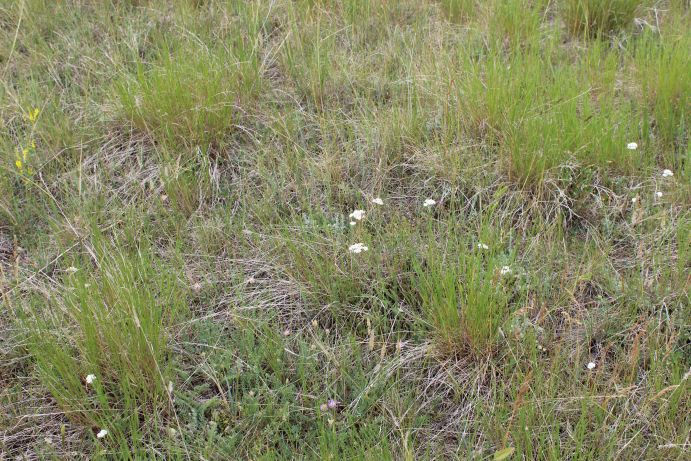
As we stand in the prairie, I wonder—is it sustainable to grow row crops in the shortgrass prairie region at all, even with no-till? Is the herbicide-resistant kochia an enemy to fight with more chemicals, or a warning that annual cropping—even with more diverse rotations and no tillage—is inappropriate for this climate? Would it be better to turn it all back to prairie and graze cattle or maybe even bison again?
I don’t have answers to these questions. Neither does Meilon. I thank him for being honest with me about his challenges as well as his successes. We stand on the prairie for a minute longer, then drive back to the huge shed. I get one last photo of the “dreaded sprayer,” as Meilon calls it, parked outside. And then I get on eastbound I-94 and spend the three-hour drive to Bismarck pondering what I’ve seen.


