Looking for the Tallgrass Prairie: Misadventures in Iowa's Prairie Remnants


August 23, 2026
When I was in North Dakota in June, I hiked the shortgrass prairie and the mixed grass prairie. There’s just one major American prairie type I haven’t experienced yet—the tallgrass prairie. So while I’m on my way to Iowa State University to look at some archives, I decide to try to find some undisturbed tallgrass prairie—which once covered over 80 percent of the state of Iowa. Everything I’ve read says that it used to be a sea of grass, waving in the wind and growing higher than the back of a horse. But now it’s a sea of corn. The undisturbed prairie is left only in tiny remnants, 20 to 40 acres—but I’m going to find as many of them as I can. It’s just a little harder than I expected.
After a few wrong turns, I arrive at my first stop, Williams Prairie. I park my car in the tiny, overgrown turnout and look for a bit at what looks like an impenetrable swamp. I knew it was a wet prairie, but this wasn’t what I was expecting at all. I thought that the tallgrass prairie would have a lot more, well, tall grass. There is definitely grass here—sedges and bluejoint grass, according to the Iowa Department of Natural Resources—but it is only two or three feet tall. And there are just as many—if not more—forbs than grass.
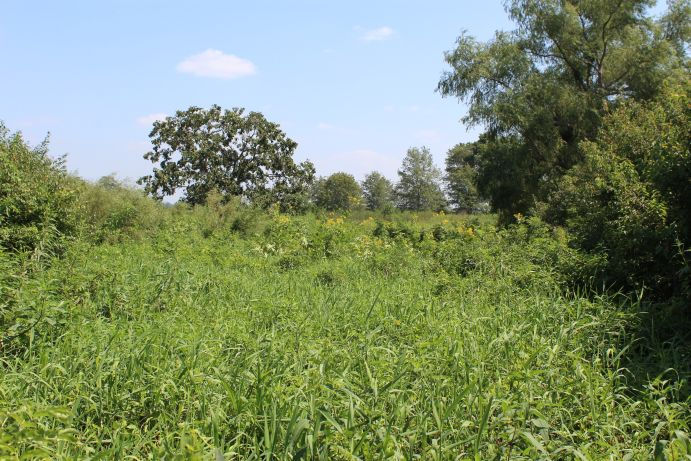
There are no trails in any of these prairie remnants, and as soon as I start bushwhacking into the thick vegetation, I regret not bringing any long pants. This grass is only mildly scratchy, but wait, are those stinging nettles? I accidentally brush against one. Ouch! Stepping into the shade of a bush, I suddenly realize that I’m standing in poison ivy. I didn’t realize that was a prairie plant!

There is diversity here—a stand of huge cup plants, big yellow flowers buzzing with bees. There’s a vining plant with pink pea-like flowers—maybe trailing wild bean? As I get into the wetter part, it becomes almost impossible to walk, and my legs are itching from the nettles. So I backtrack, trying to avoid the worst of the poison ivy, and reemerge next to my car. I splash a little water from my water bottle on my legs and hope for the best.
Google Maps really lets me down on my second stop. The directions are fine until the last turn, where it tells me to drive 0.7 miles down a road to my destination. The problem is, the “road” is actually a giant mudhole marked by a sign that says, “Caution: Minimum maintenance road. Level B service. Enter at your own risk.” One quick glance tells me my Kia Forte won’t make it, so I don’t try. Instead, I park and do the last 0.7 miles on foot.

It’s about 3:00 in the afternoon, blazing hot, and humid. Grasshoppers drone in the corn and soybean fields on both sides of the “road.” I can’t even see the prairie at first and hope this isn’t a wild goose chase. Then I crest a little hill—and there it is. There’s a wooden sign that says “Carroll Prairie,” plus a graveled parking lot. I also note that the 0.3 miles of road coming from the other direction is maintained gravel—I totally could have driven my car down that. Oh, well, too late now, and at least I’m here.
But what is “here”? I’m not sure exactly what I was expecting this prairie to be, but it certainly wasn’t the head-high thicket of mixed common and giant ragweed that I suddenly find myself pushing through. Being late August, the ragweed is blooming. And I have a moderate ragweed allergy, especially when I’m bushwhacking through thickets of the stuff. Ahhh-choo!

Farther down the hill, I spot a few prettier flowers blooming, so I bushwhack over there. At least this prairie isn’t poky, just sneezy. I find a couple nice black-eyed Susans and some goldenrod, then finally spot a couple isolated clumps of big bluestem. But the predominant species are still common ragweed, giant ragweed, and foxtails—the same annual weeds that grow in our fields back home. Are these weeds actually the prairie trying to come back? Or has this remnant just been too disturbed?
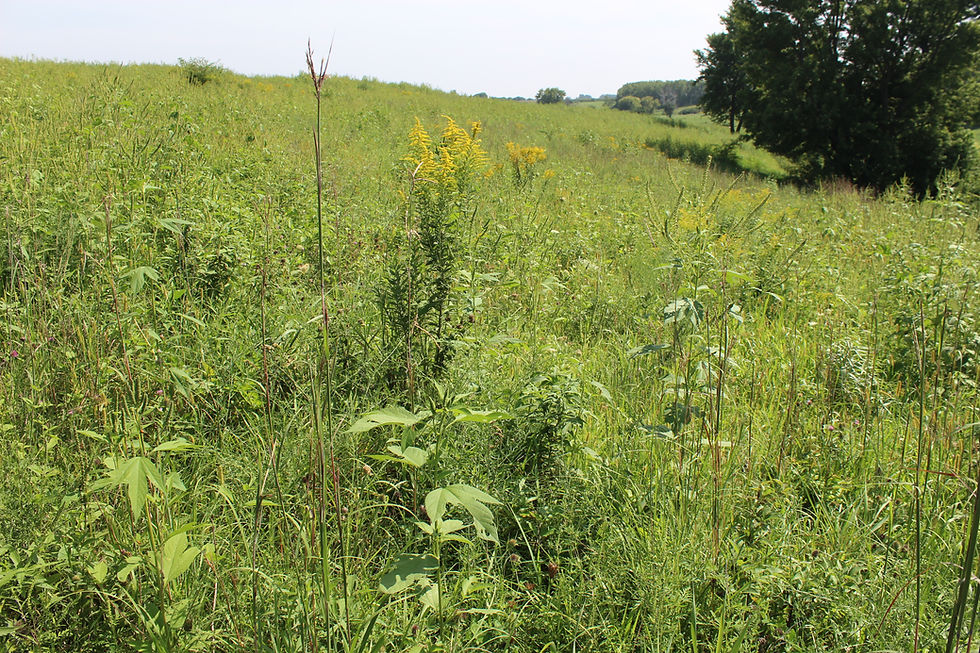
I’m still sneezing a little when I arrive at Doolittle Prairie, and I’m hot and sweaty from the cornfield hike. But I don’t want to miss this one. Everything I read said it’s one of the best prairie remnants in the whole state of Iowa, and I notice the difference immediately. There’s a fair amount of big bluestem (though most of the other grasses are not taller than me), lots of blooming flowers, and lots of prairie roses that are now covered with reddish-orange hips. I see a monarch on a blooming bull thistle. There are familiar plants like goldenrod and milkweed, too, but this remnant definitely has more diversity (and less ragweed) than Carroll Prairie.

This prairie remnant survived partly because it was swampy—it’s dotted with wet depressions called “potholes.” I try to explore one of those and discover that they’re lined with yet another kind of low, creeping grass. I take one step in and the leaves grab my leg painfully—it feels like a bug bite! Maybe I’ve run into some prairie cordgrass. As I quickly backtrack from there, I suddenly realize that I’m standing in lots more poison ivy. I’m definitely never bushwhacking in a prairie in shorts again. Why didn’t I bring pants?

Despite my scratched-up and itchy legs, I’m glad I stopped at Doolittle Prairie. It really is the most diverse and beautiful of the three. And it’s been a very educational experience. I owe an apology to all the prairie restoration projects I’ve seen—they were much more authentic than I realized. I was just confused about the “tallgrass” name, assuming that the prairie was mostly eight-foot-tall grasses. It’s not—the tall grasses grow in isolated clumps, most of the grasses are more around three or four feet high, and most of the tallest plants are forbs. And that, apparently, is what the natural prairies were like.

As soon as I reach my destination, I scrub my legs and hope for the best. It’s mostly successful—I only end up with a few spots of poison ivy rash. It’ll take a week for the cuts from the prairie cordgrass to heal and my eyes are still itching a little from the ragweed, but I’m satisfied. I can’t say I liked hiking in the tallgrass prairie as much as I enjoyed hiking in the shortgrass and mixed prairies, but at least I know now that the few remaining remnants are actually very similar to the carefully planned restorations I’ve seen. And apparently both poison ivy and ragweed are prairie plants. Ahchoo!


