The Best Soil in Bismarck: Touring Gabe Brown's Famous Ranch

June 22, 2026
Gabe Brown is arguably one of the most famous regenerative farmers in America—if not the world. He’s been featured in the films Kiss the Ground and Common Ground, and his book Dirt to Soil is one of the foundation texts of the modern regenerative movement. All the other farmers I talked to in North Dakota hold Gabe in awe, admitting that his soil looks better than theirs but not sure exactly how to replicate it. This was something I had to see.
As soon as I decided to go to North Dakota, I reached out to Gabe to see if he might be available to give me a farm tour. He’s a very busy man, but it just so happened that he had a two-hour time slot available when I was in town—between trips, lectures, and Zoom calls. When he said I could come over between 5:00–7:00 p.m. on June 22, I jumped at the chance. I’ll be there!
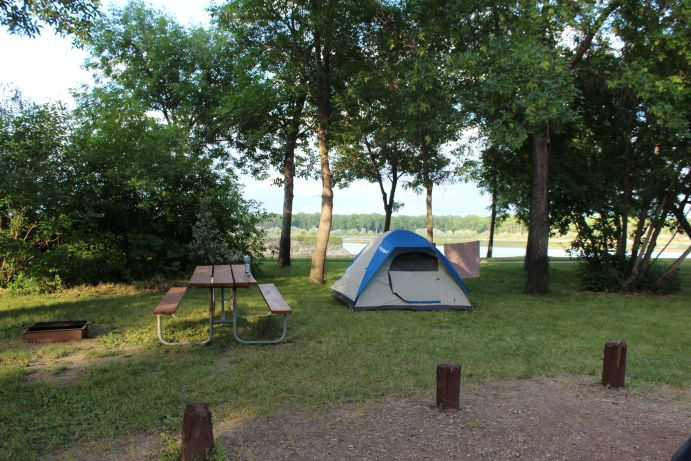
As I near Bismarck, I take a detour down to Fort Abraham Lincoln State Park and quickly set up my wet tent, in hopes that it will dry by bedtime in the prairie sun and wind. I’m doing okay on time until I reach Gabe’s exit on I-94. It’s been redone so recently that Google Maps hasn’t heard about it yet, so I accidentally get off the wrong direction and have to turn around in rush hour traffic, which loses me five or ten precious minutes. Once I finally get on the right road, I’m driving through a series of new developments of cookie-cutter houses. I did not realize suburban sprawl was such a problem in Bismarck, North Dakota.
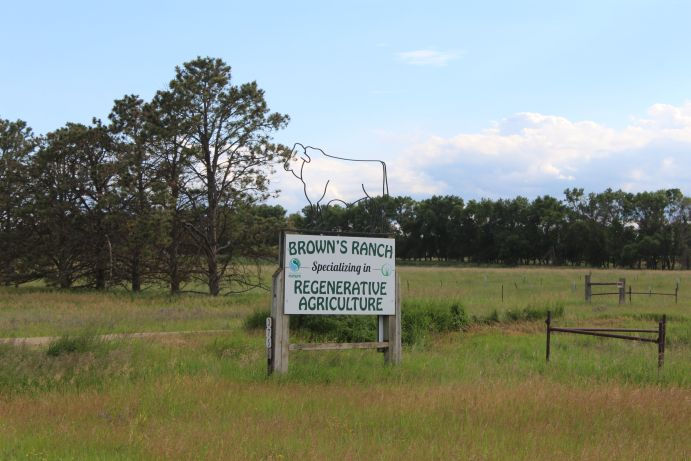
Quite suddenly, just after the last development, the road turns to dirt, and I’m back in the country. It’s nearly 5:00, but fortunately I’m almost there. One more turn down another dirt road, and there it is—a big wooden sign that says, “Brown’s Ranch: Specializing in Regenerative Agriculture.” I made it!
Gabe’s waiting for me in his truck. I apologize for arriving right on the dot of 5:00, and he says the timing is perfect. I hop in his truck, and we head right over to a field next to the driveway. “It’s a little hard to walk,” Gabe comments as we get out of the truck. The lush grass-legume planting is waist-high for him and chest-high for me. “There’s probably twenty-some species seeded in here,” Gabe tells me.
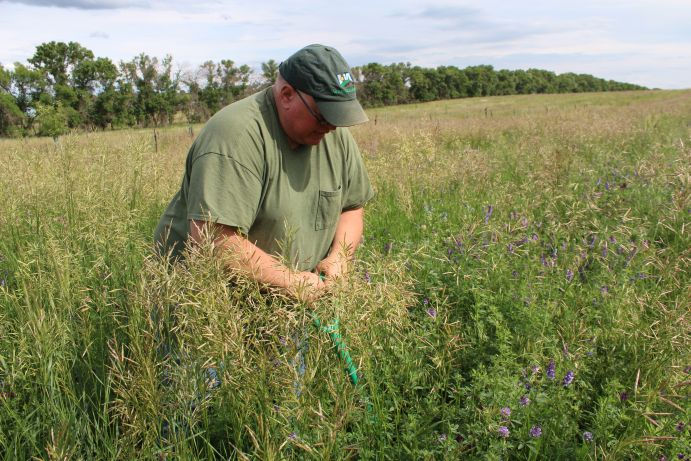
Gabe pulls a spade out of the back of his truck and digs up a shovelful of soil. I know he does this for everyone who visits, so in preparation I’ve been asking every other farmer to do the same so I can compare. And all I can say is—wow. Gabe’s soil is dark, rich, and, most importantly, well-aggregated.

Next, Gabe takes me across the street to the neighbor’s no-till wheat field for comparison. The digging’s a lot harder here, and the difference is stark. While this soil is still dark, it’s hard, platy, and compacted. “Where’s the aggregates?” Gabe asks. The plant roots are growing laterally because the soil’s too hard for them to tunnel deep. And it doesn’t have that earthy smell of Gabe’s field.

“The difference is strictly management,” Gabe emphasizes. “It’s the same soil type. It’s all Williams loam soil. It’s a really beautiful soil. But you know how well-aggregated mine was. Now look—how do the roots get through that? How does water penetrate? And my soil was just like that, back before we started no-till. And it’s not just no-till. No-till’s a small part. It’s the cover crops, livestock integration, diverse crop rotations.”
Now we’re bumping along a grass lane between fields in the heart of Gabe’s ranch. “We’ve documented 174 plant species on our ranch,” Gabe tells me. “There’s a lot of native species in here.” He knows the names of most of them, too, excitedly pointing out some nice-looking Cicer milkvetch and leadplant, two native legumes that are highly nutritious for cattle.

Some of the fields are in native prairie that has never been plowed. Others were cropped at one time and have only been back in forages for a few years. But the difference between native and restored prairie is not very noticeable. Gabe tells me that as the soil health improves, native species like big bluestem are coming back from seeds that have been buried in the soil for nearly a hundred years.
I’ve been to quite a few grazing operations, and I’ve never seen one with forages quite as lush and thick as this. Gabe explains that the key is long paddock rotations. He only grazes each field once a year, and never on the same date because that would select for certain species of plants. The cattle are left in the paddock for only one day—at most two—then moved on to the next one. We pass some recently grazed fields, and they still look better than most of the grazing land I’ve seen so far in North Dakota.

Gabe takes me up to the spot where he was standing in the film Kiss the Ground, comparing his land to his neighbor’s. The neighbor is using no-till now, but the difference is still stark. I ask if the negative publicity encouraged the neighbor to adopt some of Gabe’s practices, and he says no. Even though Gabe has thousands of visitors come out to his farm every year, few farmers in his area are using his system.
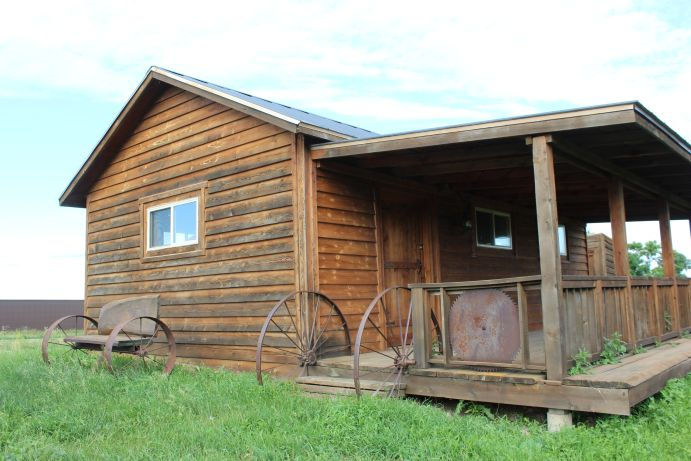
We head back to where we started, passing some pastured laying hens and the family garden. Our last stop is a cool little cabin that Gabe built for people visiting the farm to eat lunch in. I thank him for taking the time out of his busy schedule to show me around. “It is what it is,” Gabe says modestly. “I tell people, it’s nothing special, but I am pretty proud of the soil.”
I’ve seen enough already to know that Gabe’s soil is something special. Gabe knows and loves his land. He’s on a first-name basis with all the native prairie plants, showing me photos of Cicer milkvetch on his phone the way a lot of people show photos of their grandkids. He sees the soil, plants, and animals as integral parts of the whole farm ecosystem. Though he doesn’t use the word, Gabe is a true organic farmer.
It’s been an amazing evening. The traffic has calmed down by the time I drive back through Bismarck, and when I get to my campsite, my tent is completely dry, just like I hoped it would be. I sit and look at the confluence of the Heart and Missouri Rivers right behind my campsite until the sun drops behind the trees. My first day of farm tours has sure been exciting!