Looking for Buffalo Bird Woman: A Hike at Fort Abraham Lincoln State Park

It’s a beautiful, sunny morning in Mandan, North Dakota. I sit by the confluence of the Missouri and Heart Rivers and watch the sun rise behind a bank of clouds while dozens of families of Canada geese swim upstream in stately lines—one big one, two to five adolescents that are starting to get their adult feathers, and another big one.

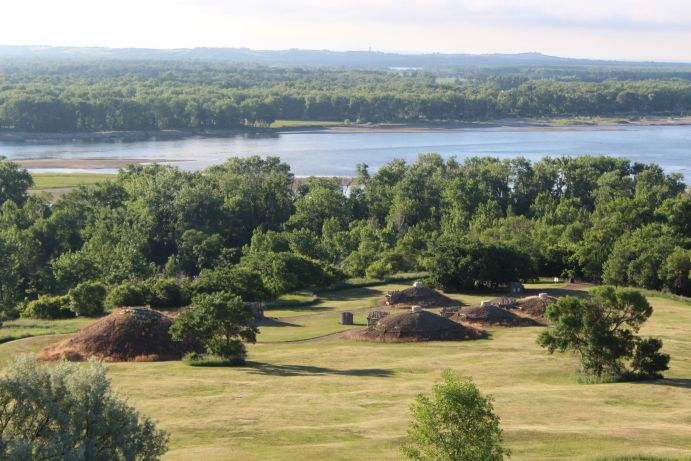
My first farm tour isn’t until 9:00 a.m., so I decide to explore Fort Abraham Lincoln State Park. I tiptoe across the still-sleeping campground to the trailhead, climb some stone steps, cross a trolley track, climb some more stone steps, head down a boardwalk, and arrive in the partially reconstructed On-a-Slant Mandan village.

This is something I want to see just as much as modern farming. There seems to be pretty wide agreement today that tilling the high and windy Plains is a bad idea. As I saw at Meilon’s farm yesterday, herbicide-dependent no-till has some serious sustainability issues, too. Gabe’s ranch seems like a very strong case that putting the land back into forages is best for everyone.
And yet—there were farmers in North Dakota before the settler era. The Mandan, Hidatsa, and Arikara were agricultural peoples who didn’t always get along with each other but had similar cultures. All three tribes traditionally lived in earthlodges. These round dwellings were built of wood and covered with earth. They were thirty to sixty feet in diameter, and ten to fifteen people lived in each one.

We know far more about Mandan/Hidatsa/Arikara agriculture than we do about Indigenous agriculture in the eastern United States, thanks to two remarkable individuals—Buffalo Bird Woman and Gilbert Wilson. Buffalo Bird Woman was a Hidatsa woman, born in 1839 in a village along the Knife River. She learned traditional farming methods before the government forced the “three affiliated tribes,” as they are known today, onto the Fort Berthold Reservation.
But we wouldn’t know anything about Buffalo Bird Woman’s agricultural knowledge if it wasn’t for Gilbert Wilson, a Presbyterian pastor and anthropologist who wanted to preserve information about Indigenous people from an Indigenous point of view—not the racist, biased viewpoint all too prevalent at the time. Wilson befriended Buffalo Bird Woman and spent years interviewing her, helping her recall everything she could about Hidatsa village life in the pre-reservation era. He collected this material in several books—including one that’s just about agriculture, called Buffalo Bird Woman’s Garden.

Buffalo Bird Woman tells in great detail how the Hidatsa (and the other agricultural Indigenous peoples of North Dakota) farmed. They grew four sisters—corn, squash, beans, and sunflowers. (Some call tobacco the fifth sister, but in Buffalo Bird Woman’s village that was cultivated only by the men, in separate plots). She describes cultivation methods, harvesting, drying, cooking, and storage.
There are so many little details in Buffalo Bird Woman’s Garden that only a farmer would pick up on—like when she talks about corn smut and how they’d cook and dry it, or when she mentions that there were occasionally worms in the corn (corn borers). And there are all sorts of other fun stories, like how the women would sit in their ripening cornfields to guard them—from birds and animals but especially from naughty boys, who would steal green corn and roast it. She even includes a song the women and girls would sing to taunt the boys.
Notably, the Hidatsa, Mandan, and Arikara did not practice no-till agriculture. When they were ready to plant a field, they broke up the ground with a digging stick, heaped the earth up into mounds, and planted corn. They planted beans and squash in separate mounds. They used hoes made from a bison scapula to cultivate between the hills and keep the land weed-free. In fact, they disturbed the soil way more than soil health advocates today recommend—but it seems to have worked, and the land is still fertile today. So how in the world did they get away with it?

As I walk through On-a-Slant village, the reason suddenly becomes clear. Location, location, location. This village is perched halfway up a fairly steep bluff (hence the stairs I had to climb to get to it). Five earthlodges have been reconstructed, and the park mows a larger area, revealing the round depressions that were formed when the ancient earthlodges collapsed. But the Mandan didn’t grow crops right next to their earthlodges—they grew them on the flat, fertile bottomlands by the river.
I follow the trail out of the village, climb higher up on the bluff, and am rewarded with stunning views of the river confluence. The hillside is covered with healthy, diverse mixed prairie—I see some Cicer milkvetch that’s even bigger and lusher than the one Gabe pointed out to me at his farm, and he’d sure love that beautiful leadplant around the corner. The hillside trail is lined with juneberry bushes, and they’re covered with sweet red berries because, well, it’s June! They sure make a yummy before-breakfast snack.

Standing on the bluff overlooking the river valley, I realize the importance of topography in Mandan/Hidatsa/Arikara agriculture. This village site is very typical, in that the village itself is up above the river but built next to an area of flat bottomlands. The flat land between the two rivers is still being farmed today, with a pivot irrigation system. The land on the near side of the river is the campground where I’m staying. I realize that my tent is very likely on land that was once a Mandan corn, bean, squash, and sunflower field.

The Mandan never farmed the high plains. They went up there to hunt bison and forage for plants like the juneberries I’ve been eating. Some of the accounts I read say that the only reason they didn’t farm the high country was because their digging sticks and bone hoes weren’t sturdy enough to break the thick prairie sod. But that’s based on the old racist view that their culture was less evolved. What if they didn’t farm the prairie because they knew it wasn’t suited for farming? What if the bottomlands really are the only land in central North Dakota that can be farmed safely and sustainably for generations to come?
Once again, I have more questions than answers. But as I stand on that bluff, looking at the difference between the flat and fertile bottomlands and the sturdy prairie vegetation holding the high plains in place with its thick roots, I wonder how agriculture in North Dakota today would be different if the government and settlers a century ago would have asked why the Indigenous people didn’t till the high prairies.


