Demonstrating Soil Health: Menoken Farm


June 23, 2026
Time for my last farm tour in North Dakota! I leave my campground, head a few miles east on I-94, and arrive at Menoken Farm by 9:00 a.m. This is a little different than the other farms I’ve toured, because it’s not a commercial operation. Menoken Farm is a demonstration farm managed by the Burleigh County Soil Conservation District, and my tour guide for the day is Darrell Oswald, the district manager.
It’s a bit unusual for a soil conservation district to own a 150-acre farm like this, Darrell tells me. He explains the unique role a demonstration farm can play in developing new farming methods. He can pivot cropping systems quickly to try new ideas, unlike an experimental farm that’s locked into a multi-year study design. Because most other soil conservation districts don’t have this large of a demonstration farm, visitors come to Menoken from all over the United States and even from other countries.
The first stop on our tour is the rain gardens behind the buildings. Then we head down to the arboretum, where the district plants every type of tree or shrub that can grow in central North Dakota (and a few that can’t). When a homeowner or farmer is interested in planting a specific plant, they can look at the demonstration gardens and see what it looks like and whether it’s going to work for them.

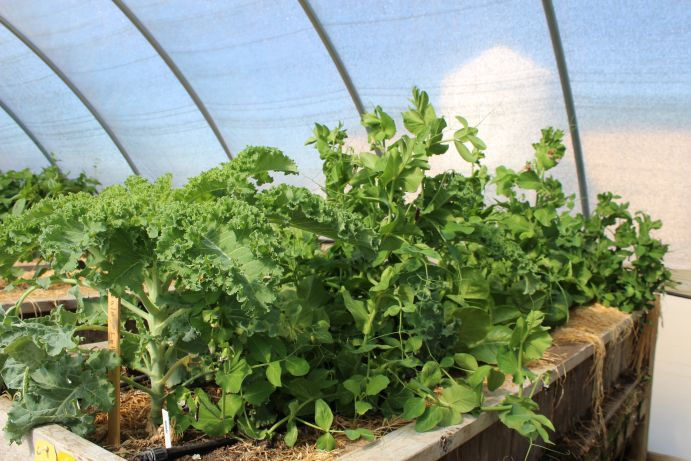
Jayden, the urban conservationist, gives me a tour of the vegetable beds in a high tunnel and outside. I ask him about his title, wondering if he mostly works in downtown Bismarck. He does do some work in the city, but he explains that in North Dakota they call pretty much any farm under forty acres “urban,” whether it’s a market vegetable operation or a homestead with a few horses. “Urban” agriculture in North Dakota is a bit different than urban agriculture on vacant lots in Detroit or Cleveland.
After the veggie tour, I hop in a side-by-side with Darrell and we head out to look at the crop fields. Menoken has ten different plots, each about twelve acres. The first one’s in perennial forages, and the others are in various combinations of no-till crops and cover crops. Darrell digs up some soil for me and it looks good—though not quite as amazing as Gabe’s soil.

Unlike the farm I visited in Golden Valley County, Menoken is managed without any commercial fertilizers. Fertility is maintained with rotations and cover crops. Darrell digs up a pea plant (used as a cover crop) and, sure enough, the roots are covered with lots of healthy-looking nodules. He has me taste a big, plump root on a young corn plant so I can see how sweet it is—that’s the root exudates that the plant is using to attract microbial partners in the soil. There’s a lot of emphasis on soil biology at Menoken. In fact, it could almost be an organic farm—except that they spray herbicides for weed control.

“So I’ve always wondered, how does that affect the soil microbiology?” I ask. “You have your soil and your plant root exudates and all that, and then you terminate the plant, and I know glyphosate is toxic to microorganisms, so how does that affect that?”
“I think that if your soil is in a state where it’s generally considered healthy, in a regenerative state, your resiliency towards those type of things is better,” Darrell replies. “I think that the healthy soil can actually break those things down.” He doesn’t like using glyphosate or other herbicides, but feels like it’s less detrimental to soil health than tillage—even conservation or reduced tillage. “A little bit of tillage is like being a little bit pregnant. Either you are or you aren’t. I don’t mean to sound crude, but that’s kind of my philosophy on it.”
Darrell’s not really worried about herbicide resistance because they’re not seeing it yet at Menoken. He thinks it should be easy to manage with crop rotations. Of course, they’ve only been doing no-till on that land since 2009—seventeen years. Over in Golden Valley County, where resistance is a much bigger problem, farmers have been using no-till for forty years.
Darrell agrees with me that the best thing for the land would be to put it all back in perennial forages like Gabe does. The big challenge is government programs that support row crop agriculture in a region that may not be suited for it. He feels like no-till is the best way to build soil health in the current system. And maybe it is.

But I still am not convinced that any system that can’t function without herbicides is sustainable. Spraying poison on the land just doesn’t seem right to me. And it’s not just glyphosate—plants and soil microbes share so many metabolic pathways that I find it hard to believe that any herbicide has zero impact on soil life.
I still don’t have all the answers. Neither does Darrell. I thank him for taking the time to give me a tour. It’s been very educational—I’ve confirmed that tillage is the number one reason many soil health advocates are somewhat anti-organic. I’ve also discovered that the most adamant advocates of no-till live in climates where tillage is extremely detrimental. I understand now where they’re coming from and why they defend herbicides so strongly.
But I’ve also seen, over in Beach, where no-till is headed. The time will come when kochia and other weeds in Menoken develop herbicide resistance. And then what will happen to North Dakota’s soil health movement? Will it abandon herbicides and become fully organic (which might mean an emphasis on forages over row crops), or will it fizzle out as farmers revert to destructive tillage practices? Only time will tell.


